Wrapping Tutorials
Autumn Vase Arrangement Tutorial: Airy Height, Yellow Sprays and Dark Contrast
Oct
Last updated:
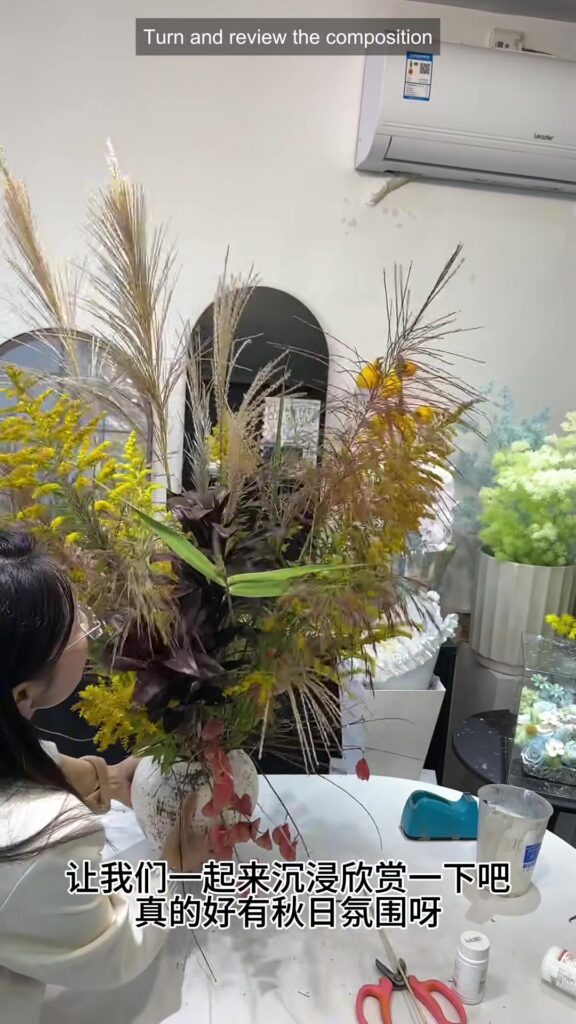
This autumn vase arrangement tutorial is best studied as a composition developing over time. The opening views show airy tall stems, yellow branching sprays and reddish hanging details beside a mottled light vase. The maker prepares a loose wire-mesh support and builds the arrangement upward and outward, then adds darker foliage and smaller details near the center. Several hand movements are hidden by the maker’s body, so the written stages explain the visible changes in the outline without pretending that every insertion point is shown.
Materials shown in the demonstration
- A rounded light-coloured vase with dark mottled markings; vessel composition and dimensions are not identified
- A loose wire-mesh support shown before placement
- Tall feathery stems, yellow branching sprays and reddish hanging stems
- Dark burgundy foliage and finer branching details
- Cutting tools visible during stem preparation; no measured stem lengths are supplied
Follow the visible steps
- 00:00–00:18 — Review the stem shapes The camera moves across the materials beside the vase. Tall feathery stems create a different line from the branching yellow sprays and reddish hanging details. This guide uses those visible shape and colour descriptions rather than assigning unverified plant varieties or repeating a foraging claim.
- 00:18–00:38 — Observe the loose mesh support The maker shows a loose wire-mesh structure and works it toward the vase opening. The clip does not provide a cutting pattern or measured folding sequence. Some of the placement is hidden, so the mesh is identified as a visible support rather than a fully demonstrated fastening method.
- 00:38–00:50 — Keep the preparation limits clear The maker continues working at the vase opening with parts of the preparation obscured. An unidentified additive appears in the source. This visual guide does not identify a chemical, supply a dose or repeat an unverified claim about antibacterial action or vase life.
- 00:50–01:08 — Establish the tall airy outline Long feathery stems are prepared and placed at different heights and directions. Their upper lines remain separated rather than forming a dense block. Watch how the highest stems define the space available for the lower colours.
- 01:08–01:36 — Add the yellow and reddish layers Yellow branching sprays build the main colour area around the taller stems. Reddish hanging details are then extended outward and downward. Some insertion points are blocked by the maker, but the changing arrangement shows how the upper and lower lines differ.
- 01:36–02:16 — Add central contrast and fill lower gaps Dark burgundy foliage is placed near the middle, followed by additional smaller yellow and fine branching details. The maker checks and adjusts the outline. The guide describes those visible additions without prescribing hidden stem angles or a particular attachment tension.
- 02:16–end — Turn the vase and compare the silhouette The maker rotates the vase for the closing views. Compare the airy upper stems, the yellow branching layer, the darker center and the reddish hanging line below. This is a complete source clip but a partially obscured process demonstration, not a close-up lesson for every hand movement.
Compare height, central contrast and the hanging line
The tallest stems establish the open upper silhouette. Yellow sprays bring colour into that space, while dark foliage concentrates contrast near the middle and reddish details extend below it. Studying those areas separately makes the visible changes easier to follow, especially where the maker’s body hides the hands. Use the final rotated views to compare the balance from more than one side.
Keep material identification and care advice separate
The footage establishes visible colours and shapes, not exact plant varieties, quantities or a product specification. The loose mesh support is shown, but its dimensions and many insertion details are not. The unidentified preparation additive is not reproduced as a recipe. Choose actual support and care requirements from identified materials rather than turning this composition reference into an unverified treatment claim.
The Instagram tutorial
Watch the same demonstration on FAFAFLOWER’s Instagram.
More wrapping references
Compare the panel order in our lavender layered wrapping tutorial, or read What Paper Do Florists Use? for material selection.
Music: “Paper Wings” by Jason Shaw / Audionautix — source. Licensed under CC BY4.0. Changes: Excerpt, fades and level adjustment.
Video source: 花菇凉.flower on Xiaohongshu, shared with permission. Original design and footage remain credited to the creator; FAFAFLOWER added the English visual steps. These written notes describe the visible process and are not a verbatim audio transcript.
