Wrapping Tutorials
Round Pink Flower Display Tutorial: A Fitted Support and Layered White Wrap
Oct
Last updated:
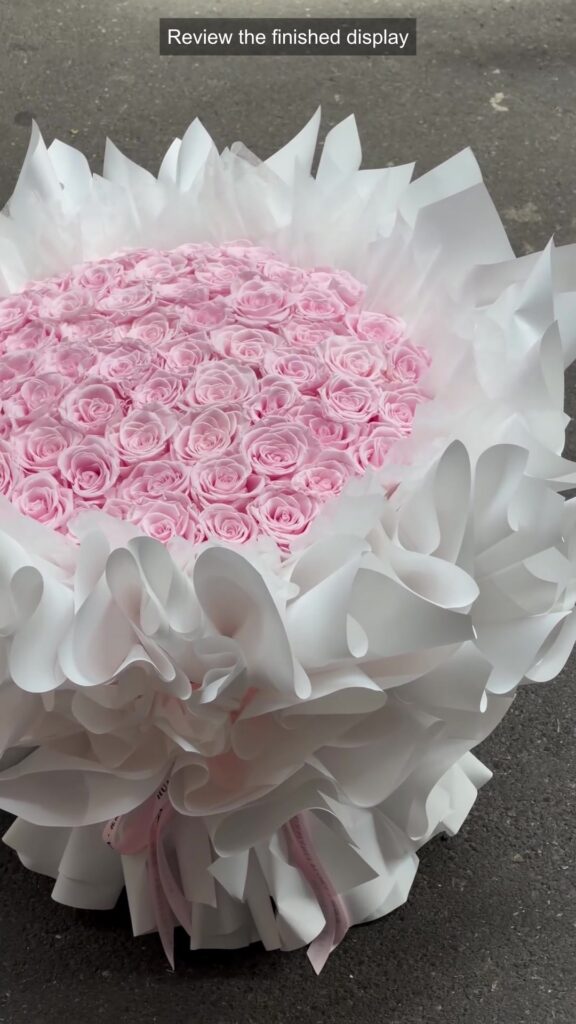
This round pink flower display tutorial uses a container and a fitted green support rather than a hand-held bundle of natural stems. Pink flower heads stand on clear support rods, which are arranged into a dense circular face. The maker then builds the wrapping outward: pale translucent inner panels, pointed white outer pieces and a folded lower cover around the container.
Materials shown in the demonstration
- A patterned container and green support blocks fitted to its interior
- Pink flower heads on clear support rods; the source labels them preserved, but treatment and exact count are not independently verified
- Pale translucent inner wrapping panels; exact composition is unidentified
- White outer wrapping sheets and thin supporting sticks visible during the panel stage
- Securing materials, scissors, pale ribbon, a finishing card and a turntable
Follow the visible steps
- 00:00–00:18 — Fit the support inside the container The maker trims green support pieces and fills the lower part of the patterned container. A larger piece is shaped to fit the round opening. This establishes the support geometry before the flower heads are added; no universal container diameter or cutting template is supplied.
- 00:18–00:56 — Build the round pink flower face Flower heads on clear rods are inserted into the support. The maker starts an outer circle, fills the remaining spaces and adjusts the height and spacing. A securing step is visible around the rods. These are support rods, so the process should not be described as tying natural flower stems into a hand bouquet.
- 00:56–01:18 — Check the circle and add the inner panels The container is placed on a turntable so the outline can be checked from different directions. Pale translucent panels are then added around the flower circle. Their visible folds form the first wrapping edge; the source does not establish their material composition from the colloquial name alone.
- 01:22–01:38 — Add the pointed white outer layer White pointed pieces overlap around the outside of the translucent layer. The maker works around the container and secures the lower connection. The side view helps compare the outer points with the lower inner folds, although some fastening movements are partly obscured.
- 01:38–02:04 — Cover the lower container and add ribbon The lower white sheets are folded back and forth and arranged around the container. The gathered area is secured and finished with pale ribbon. Some of the maker’s hands and body cover the lower connection, so this guide describes the visible order rather than inventing hidden fastening details.
- 02:04–end — Compare the completed layers The final views show the dense pink circle above multiple white wrapping edges, a pale bow and a card. Compare the height of the flower face with the pointed outer panels and the lower folded cover. The source label does not independently verify flower count, preservation treatment or a care-performance claim.
Treat the container and wrapping as two connected outlines
The container holds the circular flower support, while the wrap extends beyond it. The first translucent layer softens the flower edge, the pointed white pieces add height outside that edge, and the folded lower cover connects the display to its base. Compare those three wrapping areas separately before changing the density or height of a similar display.
Keep this display method distinct from fresh-stem care
The source calls the flowers preserved and shows clear support rods, but this guide does not independently establish the treatment or exact flower count. Its unwetted support should not be turned into general advice for fresh flowers. The container graphics, support pieces and wrapping are visible material categories, not evidence of a specific FAFAFLOWER product or a verified material performance.
The Instagram tutorial
Watch the same demonstration on FAFAFLOWER’s Instagram.
More wrapping references
Compare the panel order in our lavender layered wrapping tutorial, or read What Paper Do Florists Use? for material selection.
Music: “Paper Wings” by Jason Shaw / Audionautix — source. Licensed under CC BY4.0. Changes: Excerpt, fades and level adjustment.
Video source: 陈三岁的花 on Xiaohongshu, shared with permission. Original design and footage remain credited to the creator; FAFAFLOWER added the English visual steps. These written notes describe the visible process and are not a verbatim audio transcript.
